Conquering the Stone City of Petra and Meeting the Bedouins
- Leo

- May 12, 2014
- 3 min read
Updated: Mar 14
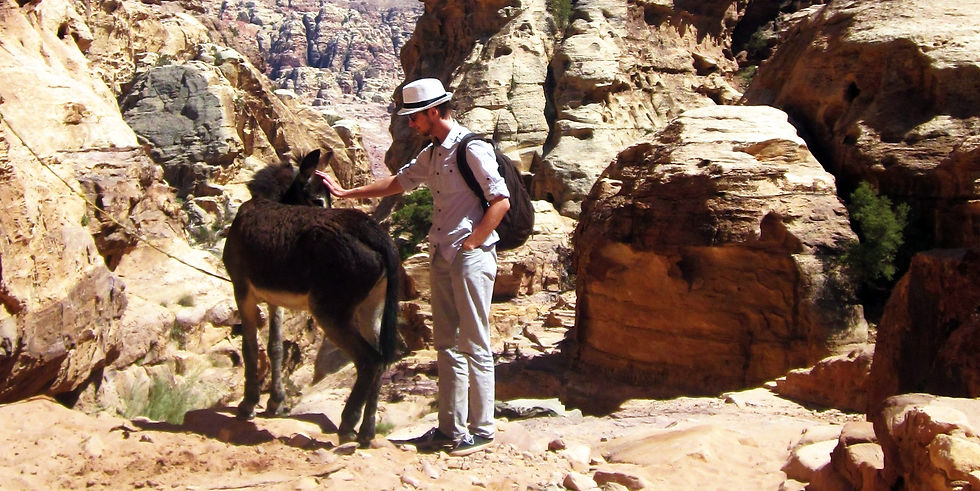
As planned the previous day, I try early in the morning to enter Petra through a side route. I quietly slip past a guard standing near a cave with a jeep, cross an old bridge over a gorge, and manage to get surprisingly far.
After about an hour of climbing among the rocks, I reach a point where the only way forward requires a small jump. The problem is obvious: how would I climb back up afterward? Meanwhile, the sky has turned completely cloudy and it looks like rain might start soon.
I decide to turn back, grab something to eat, and then enter Petra through the official entrance.
Even there I run into a small problem. I don’t have my passport with me, which is required to prove that I’m staying in Jordan rather than Israel. With proof of a Jordanian stay, the ticket costs 50 euros instead of 90.
After wandering around Petra for some time, I run into Asuncion again, the Spanish woman who lives and works in France. Walking around with her for quite a while, I learn that she once worked at McKinsey & Company, one of the world’s most prestigious consulting firms.
It also turns out that she has visited roughly as many countries as I have, always traveling as a backpacker. The difference is that she has done it gradually over many years, while I have visited many of my destinations during a single longer trip.
One place that left a particularly strong impression on her was Brazil, which she has visited five times.
Eventually we part ways, and I sit down by the roadside where several local women and children are cooking food in a pot next to their souvenir stand. They invite me to join them. I offer to pay, but they refuse.
I eat their bread with some spread and drink extremely sweet tea.
As we talk, I learn that they are Bedouins, traditional nomadic herders who live in a nearby camp. One of the older girls even has an iPhone (she explains she is the second wife of her husband), while the others are fascinated by my MP3 player and camera, taking turns examining them.
Meanwhile the mother experiments with my sunscreen.
At some point I start helping them at their souvenir stall, calling out to passing tourists in English with the same phrases they use:
“Everything only one dinar! I give you very good price! Happy hour!”
Most tourists laugh when they hear this, and a few ask how I ended up there.
Later Asuncion walks by again and takes a few photos of us at the stall.
Eventually the Bedouins pack up their goods and begin heading back home. Since they have invited me several times to visit their camp, I decide to go along. One of the girls offers to show me the way.
The younger girls smoke cigarettes. The girl guiding me tells me she doesn’t attend school, and out of seven siblings only two go to school.
After walking for about 45 minutes, she asks me to exchange 20 dollars into euros, giving a vague explanation. Soon after, she more directly asks for money — suggesting I give her 20 euros and she might return some change.
At that point I firmly tell her that she shouldn’t expect any money from me.
She almost begins to cry, sits down by the roadside, and starts deleting all the photos she took during the walk. I tell her to go ahead.
But when she tries to delete the photos that include me with her family, I take my camera back.
Since I roughly know where we are by now, I start walking toward the main road to return to town.
Fortunately I manage to hitch a ride in a taxi already carrying three local men who are in a cheerful mood. I explain that I no longer have local currency — I spent my last money on a plate in Petra — but I can withdraw cash in town.
They reply in English that money is not a problem.
One of them speaks a little Russian and I understand that he is at least partly Armenian. The driver himself knows only one English phrase:
“Welcome to Jordania!”
After the others get out, he responds with that phrase to almost everything I say.
Still, I make it safely back to the hostel.
In the evening, some locals are playing music in the hostel. One of the instruments is the oud, a traditional instrument similar to a lute that has existed in the region for over 5,000 years.
Another tourist — a Korean guy — is being taught how to tie a traditional turban, and naturally, once the lesson is finished, he is also asked to pay for it.




Comments