
Arrival in Israel. The Mystery of the Lost Bag

I land in Tel Aviv at half past midnight and join the long line at passport control. I have heard that sometimes young people traveling alone can be interviewed for up to two hours by Israeli immigration officials.
The immigration officer begins asking questions.
Officer: “What is the purpose of your visit?”Me: “Vacation.”
Officer: “Where do you plan to go?”Me: “Tel Aviv, Jerusalem, the Dead Sea…”
For now I leave Jordan unmentioned, since it is known to be a country that has been hostile toward Israel and has fought wars with it in the past.
Officer: “Are you traveling with anyone?”Me: “No.”
Officer: “Will you meet any travel companions here?”Me: “No.”
Officer: “Do you have friends in Israel?”Me: “Not really.”
Officer: “Where will you stay?”Me: “In a hostel.”
Officer: “Do you have a printed reservation?”Me: “Yes.”
I take it out and show it.
The officer looks at it, hesitates for a moment, and then hands me a small entry slip with a stamp allowing me to enter the country. They do not stamp passports anymore, partly out of courtesy, since travelers with an Israeli entry stamp may be denied entry to countries like the United Arab Emirates, Qatar, and several other Arab states.
Stepping outside the airport, I find myself in the warm Tel Aviv night—over 30°C. From there I board a train that goes from the airport into the city.
When the train stops at the first station, I notice the name is not the one I expected. A man on the train sees me studying the map in confusion and offers to help. He explains that my stop is actually in the opposite direction from where the train is currently going. I thank him and get off.
Only when looking at the route map on the platform do I understand what happened: the night train simply skipped my station, going two stops further instead.
I try to exit the station from one side, but that exit is closed for the night. I have already passed through the gate and no longer have a valid ticket. While figuring out what to do, I use the opportunity to withdraw my first Israeli shekels from an ATM.
Fortunately a local couple ahead of me has made the same mistake. They buy a special re-entry ticket from a machine to get back inside the station. I do the same.
Back inside, I ask a security guard how to reach my hostel from here. He says the only option now is a taxi.
Outside, the taxi drivers are waiting. They say the cheapest price they can offer is 40 shekels (about 8 euros). According to them, there is some kind of holiday, which means taxi meters use a higher tariff. I’m not entirely convinced, but the price is only 10 shekels more than what the hostel instructions said a taxi should cost from the correct station.
I finally arrive at the hostel sometime between three and four in the morning.
It turns out the taxi drivers were telling the truth: Israel’s Independence Day celebrations are currently underway—one of the country’s biggest holidays.
At the hostel they show me to my reserved bed. It turns out to be located on the terrace, which also serves as the hostel’s sitting area. A small group of English-speaking travelers is still awake there, celebrating the local holiday with a bottle.
After the previous sleepless night at the airport and the long journey, I am completely exhausted. With the help of my faithful travel companions—earplugs—I fall asleep almost instantly.
I wake up for the first time at 8 a.m., when breakfast is being served on the same terrace where I slept. Somehow I manage to fall back asleep and stay there until 10 a.m., when the bright sun finally becomes too annoying.
While eating breakfast, someone begins writing “good morning” greetings in different languages on a nearby board. One girl is dictating the Finnish version. I add my own contribution, and soon the board also reads “Tere hommikust!” with a small drawing of the Estonian flag.
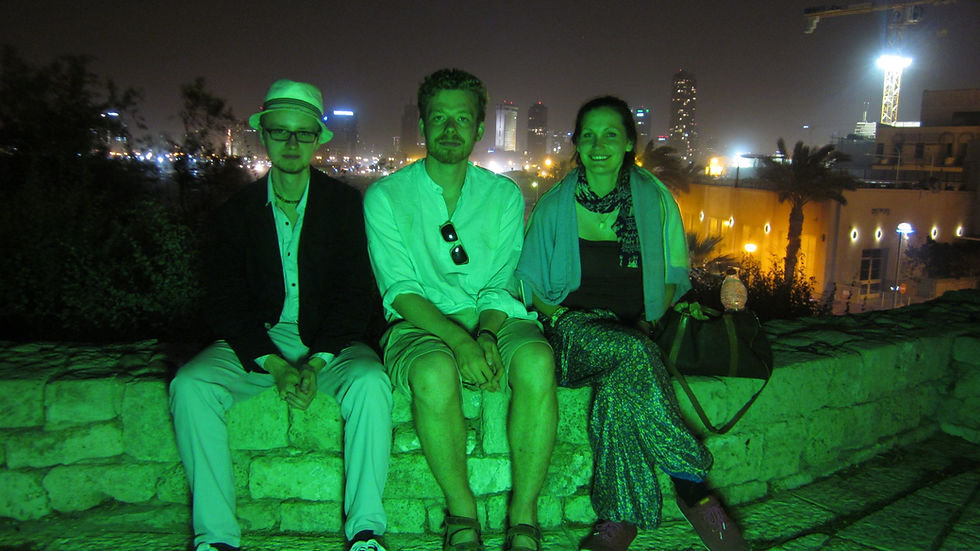
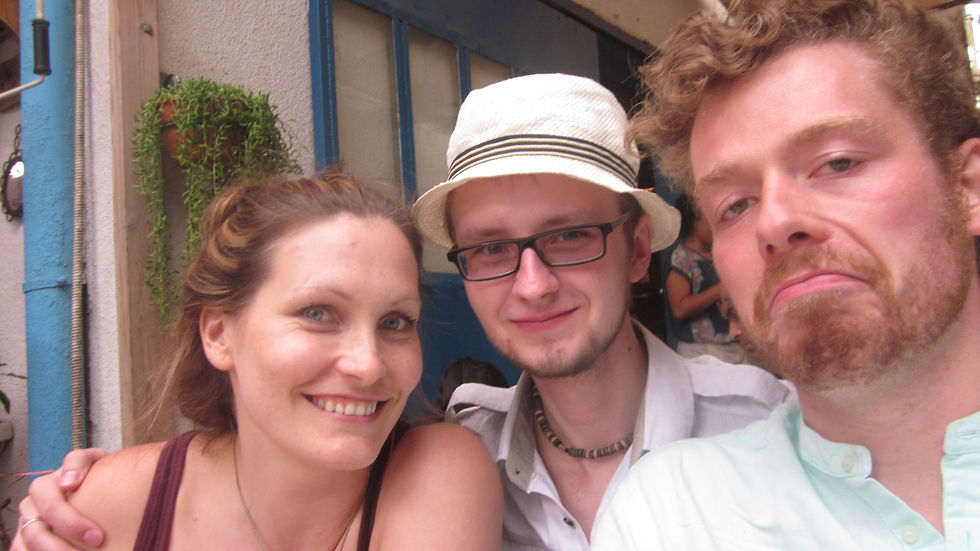
The Finnish greeting was dictated by a girl named Daniela. Her father is Serbian and her mother Finnish. She works for a company that sends people to different places for one-month stints as waiters or waitresses. The job allows her to decide at any moment that she won’t work for the next month—or longer. During those periods she travels. She says she can no longer imagine tying herself down to anything permanent.
This is her second time in Israel and also her second stay at this hostel. She is working here as a “volunteer,” which means she stays for free but works occasional six-hour shifts helping with hostel duties.
At breakfast Daniela is talking with an Austrian guy who explains that he lost his bag the night before when they were out. The problem is that he can’t remember in which bar it happened. Daniela offers to help him search for it and invites me to join them. I decide to come along.
The Austrian’s name is Günter. He has come to Israel for an internship at the Austrian embassy. He has been staying at the hostel temporarily and is supposed to move into his own apartment later that day.
We arrive in a nearby bar district, and there are a lot of places—about twenty bars in the area. Daniela remembers leaving earlier that night, before the last place they visited. Günter recalls that there had been a small grocery store across the street from the bar.
When we reach one of the bars he suddenly exclaims:“This was the place! I’m sure of it!”
We go inside. No bag.
Maybe it wasn’t that place after all.
We continue searching. Another bar—currently closed. Then another. Across the street from almost every bar there seems to be some small shop, which doesn’t help narrow things down at all.
Later Günter remembers that the entrance had been a dark door. Then he recalls that there were stairs going either up or down. Still not much help.
At about six or seven different places he becomes absolutely convinced each time that this must be the right bar.
At one point a tattooed old man promises to ask around about the bag. First he asks where Günter is from, and when he hears Austria he says he has no problem with that at all—he especially likes Austrians and Germans.
Later a couple of locals walking a dog help us search as well. They even invite us to come grill on their apartment balcony later. Apparently such balcony barbecues with loud electronic music are quite common here.
After two hours of searching, we have checked almost every place. We decide to return later once all the bars open again.
Standing in front of one place—the same one where we had started earlier—Günter suddenly wonders aloud whether the words “public house” written on the window might mean some kind of brothel.
I tell him it probably just means a pub.
At that moment a passing local overhears us and says in English:“That’s the best bar there is!”
Now Günter and Daniela begin discussing the details: apparently there had been a bar counter you could dance on (which they apparently did the night before) and also a pool table. With every minute Günter becomes more convinced that this must be the place.
After grabbing something to eat, we return to the public house—actually a pub. The bartender even recognizes Günter. At first they say they haven’t seen any bag.
We are already preparing to accept that it was probably stolen, when suddenly someone brings it out from a back room.
Inside are Günter’s phone and sunglasses.
We are all extremely relieved and happy that the lost bag mystery has finally been solved.




Comments