
The Accident That Didn’t Happen. In an Omapaha Himba Village and a Luxurious Safari Lodge

Updated: Feb 22
On Sunday, we continue from Omaruru toward Etosha National Park. After driving for quite some time, we suddenly notice a tortoise in the middle of the road. I slam on the brakes and manage to stop the car just 20 centimeters from it. All six species of land tortoises found in Namibia are endangered (only South Africa has more species), so it’s truly fortunate that we didn’t run it over with our Toyota Hilux. We carry it safely to the roadside and continue our journey.
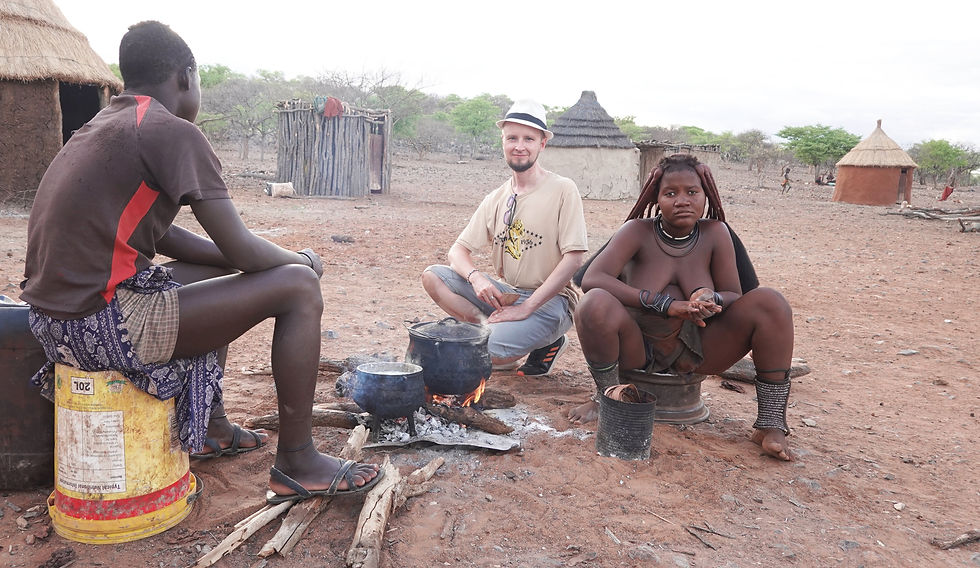
In the afternoon, we arrive at Omapaha village, where we have the opportunity to learn about Himba culture. The introductory text on the village’s website sounds promising:
“Omapaha Himba Village is affiliated with Otjikandero Himba Village. These two villages work together to support and preserve Ovahimba culture, enabling them to continue their traditional tribal lifestyle and care for orphans within the tribe.
Due to the severe drought in recent years at the Cauas-Okawa farm in Namibia, where Otjikandero village is located, we received assistance from farmer and friend Mr. Jakkie Robberts at his farm, Vierling. Thanks to additional grazing land for the Otjikandero Himba tribe’s livestock, part of the Otjikandero community relocated to Vierling Farm. The daily life and traditions of the Himba people continue at Vierling just as they do at Otjikandero. Therefore, we welcome you to visit Omapaha Himba Village at Vierling Farm.
Please note the following:• Omapaha is not a performance village or a ‘human zoo.’ It is a cultural exchange where visitors can learn about these remarkable nomadic people before their heritage may be lost forever as the Western world advances at the speed of light…• The villagers are currently caring for 15 orphaned children. Income from these visits is used to support them and the families responsible for their care.• Additional donations (such as food, etc.) are not necessary, as the visit fee covers all the villagers’ basic needs.• Pencils and other stationery, empty water bottles and plastic bags, clothing, or other items of Western civilization are not allowed in the village. The children are not accustomed to such items, and once the novelty fades, the village quickly becomes covered in trash. They do not understand the concept of ‘Western waste,’ and we have had to hire someone to clean the village after guests left empty bottles and similar items behind. It also teaches children to beg, which we want to avoid at all costs.”
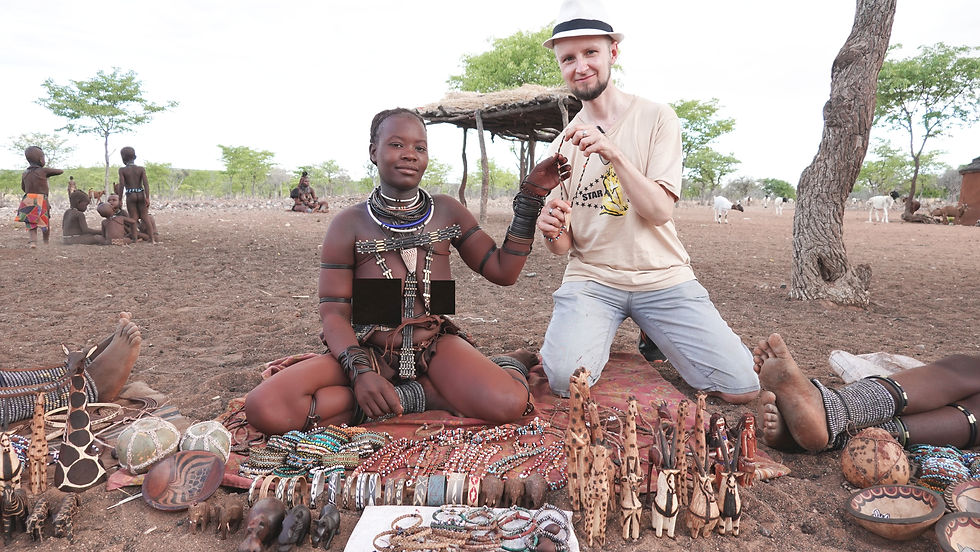
Once again, there are no other visitors during our tour — just a couple of white tourists leaving as we arrive. Our guide shares many fascinating details about this tribe that continues to preserve its traditions. For example, polygamy is still customary, and a man may take one wife for every five cows he owns — ensuring he can provide for them.
He also teaches us a few words in their language, which we use whenever we are introduced to groups of villagers:
“Moro” – “Hello!”
“Perivi” – “How are you?”
“Naua” – “Fine!”
“Okuhepa” – “Thank you!”
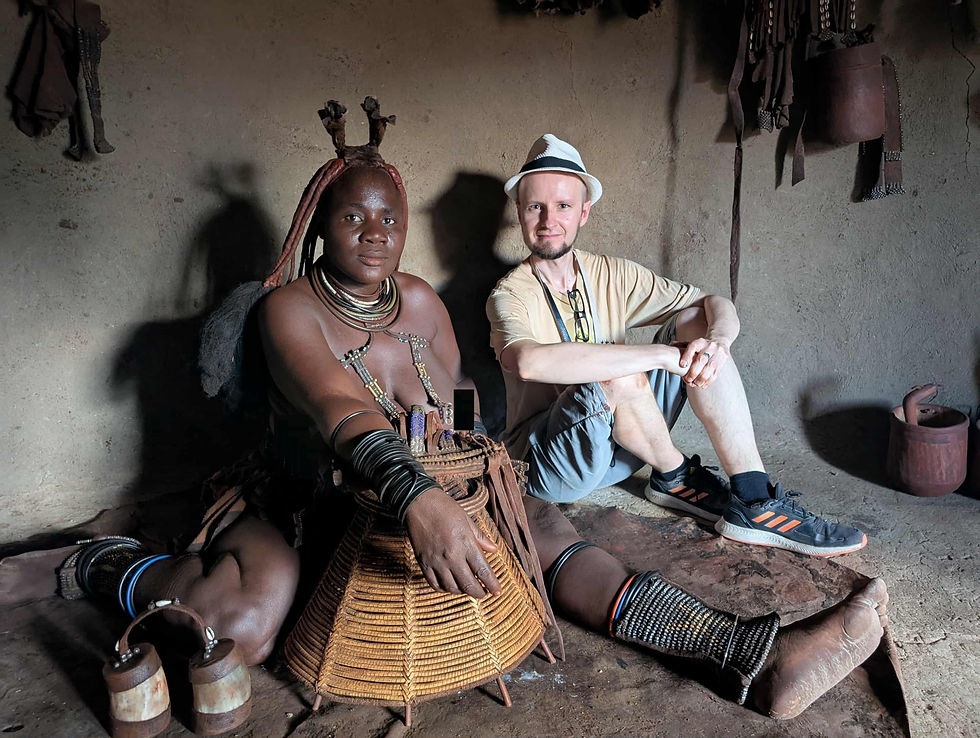
We are taken into the hut of the village chief, where his daughter demonstrates how she cleanses herself with smoke. She also shows us that her lower front teeth have been removed — a practice typically performed on women during adolescence, though in some communities also on men. It is considered a sign of beauty and cultural identity.
After the thorough tour, we drive to Okutala Etosha Lodge, located in the middle of the Okutala private game reserve, where we will stay for the next few nights. As soon as we pass through the gates, we see giraffes feeding and various antelopes running around. The private reserve is enormous.
Upon arrival, we are welcomed with a drink and immediately guided to a three-course dinner on a high outdoor terrace, where we can watch animals drinking at a waterhole below. Fewer than ten tourists are dining there alongside us. November marks the beginning of the low season here.
After dinner, we are taken with our luggage to a separate cabin even higher up on the hillside. Since the first rains of the wet season have recently fallen, the area is swarming with jumping and flying insects that immediately rush toward any light source and try to get inside. To step outside and then re-enter the cabin, we have to turn off all the lights indoors first. The beds are equipped with mosquito nets, though we hardly see or feel any mosquitoes. The only creatures occasionally moving along the walls or ceiling are a few spiders. We simply let them be.




Comments